
Article
Are Your Customer Communications Delivering Results, or Just Being Delivered?Scott Mulkey, M-EDP • November 15, 2026 • 7 min read
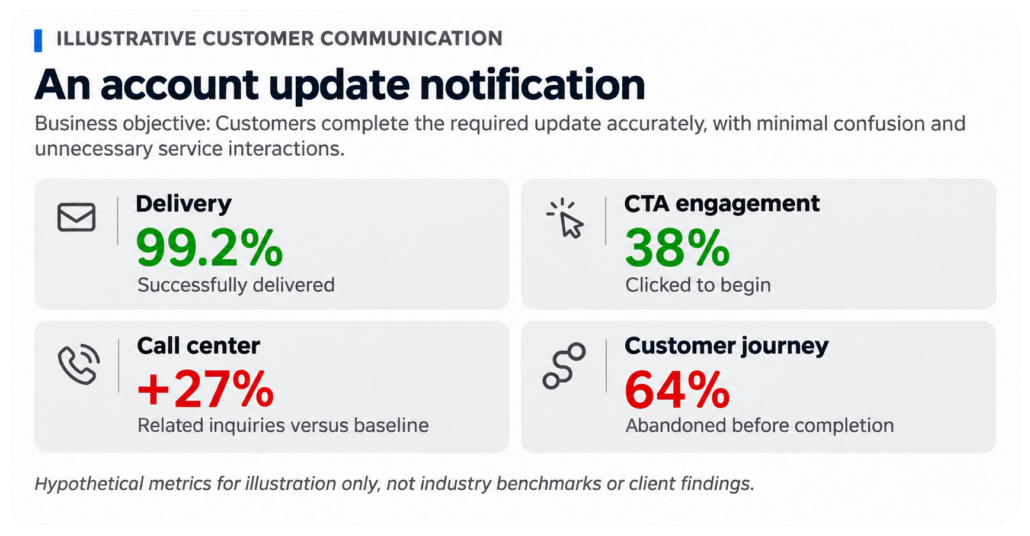
The operations team reports that delivery targets were met. Digital engagement looks encouraging. Yet customer service is receiving more calls about the same issue, and customers who begin the requested action aren’t consistently completing it.
Which team has the right performance numbers? Possibly all of them.
Each department may be accurately reporting the results it is responsible for measuring. Production completed the work on schedule. Customers received the communication and responded to the call to action. Meanwhile, the contact center is managing an unexpected increase in inquiries, and the business is seeing fewer completed transactions than anticipated.
So, was the communication successful?
That depends on whether we’re measuring how well the communication was delivered or whether it accomplished what the business intended.
As organizations review their 2026 performance and establish priorities for 2027, this distinction deserves attention. An organization can have accurate, positive performance reports across several departments while still struggling to achieve the business outcome those activities were intended to support.
And the solution may lie in the communication, the customer journey it supports, or the connection between them.
When Every Department Reports Success
Consider a financial institution notifying customers that an important account update is required. The communication is accurate, approved, and delivered through the intended channels. Customers respond to the call to action and begin the online process.
Delivery and engagement results meet expectations, but the business unit reports fewer completed updates than anticipated. Customer service is also receiving more inquiries.
At a planning meeting, someone suggests more personalized messaging or additional digital engagement capabilities. Both could be worthwhile investments, but customers are already responding. The problem appears to occur after they do.
The operations team can verify delivery, the digital team can examine customer activity, and customer service can identify recurring questions. Each has valuable information, but the business needs to understand how those activities connect.
This is where a broader Communications Experience Management (CXM) perspective becomes important. Rather than evaluating the communication as an isolated event, the organization can examine its contribution to the customer journey, from the initial notification through the intended action and any assistance required along the way.
The question changes from how to generate more engagement to why engagement isn’t producing the expected result.
What Changes When You Follow the Evidence?
Let’s extend the hypothetical example.
By mapping the journey and reviewing customer activity alongside service inquiries, the organization discovers that customers often stop at a step requiring information they were not told to have available. Some leave to locate it, others call for assistance, and some never complete the update.
The communication successfully prompted action, but the experience that followed introduced an unexpected obstacle.
Now the organization has a more specific problem to address. It could revise the notice to explain what customers need before beginning, change when it’s requested, or make it easier to save progress and return later.
Rather than assuming which change will work, the organization can test alternatives and evaluate their effect on completion rates, customer inquiries, and the overall experience.
This is where journey mapping, communication design, and testing become valuable together. Mapping helps identify where customers encounter difficulty. Testing helps determine whether a proposed change addresses it. Performance measures then provide evidence of whether the improvement is working.
The findings might support investment in additional technology, but they may also reveal opportunities to improve existing processes and communications.
A communications problem is not necessarily a problem with the communication itself.
More importantly, the organization has moved from measuring individual activities to understanding how those activities contribute to the intended business outcome.
Not Every Communication Needs a Response
Of course, not every communication is intended to generate customer action.
Consider a utility notifying customers about changes to their billing arrangements. Its purpose may be to explain the changes clearly and satisfy applicable notification requirements. Customers who understand the notice may have no reason to respond.
Low engagement doesn’t necessarily indicate failure, just as silence doesn’t establish understanding. The appropriate measures depend on what the communication is intended to accomplish.
A payment reminder, insurance policy notice, monthly statement, and account-opening communication all serve different purposes. Some require action. Others provide information, support decisions, or fulfill specific regulatory obligations.
Before evaluating effectiveness, organizations need to define what success means for the communication being measured.
That may seem straightforward, but the people responsible for producing and delivering a communication are not necessarily the people accountable for the business outcome it supports.
And that brings us to a larger question: who owns the result?
Who Owns the Communication and Its Results?
Customer communications involve many functions, each with its own responsibilities.
Print and mail operations manage production accuracy, throughput, service levels, and delivery costs. Digital teams monitor electronic delivery and customer interactions. Customer service manages inquiries and resolutions. Business units are responsible for the processes, requirements, and customer relationships that drive the need to communicate.
These functions have distinct but necessary responsibilities. Accurate production, reconciliation, and reliable delivery remain foundational, whether or not a communication generates an observable customer response.
But who owns the communication itself, and who is responsible for ensuring it continues to fulfill its intended purpose?
In some organizations, the answer becomes less clear over time. Communications are approved, automated, and moved into production. Business priorities change, responsibilities shift, and the communication continues to operate without the same level of attention given to its original development.
The issue isn’t necessarily whether communications governance is centralized or federated. Both approaches can work. What matters is that ownership, decision rights, and responsibilities are clearly defined, maintained, and actively exercised.
Organizations regularly review and refresh their branding. Yet the communications that represent that brand through statements, notices, and customer interactions may not receive the same level of attention. This is another important aspect of Communications Experience Management (CXM): ensuring that communications are actively governed, measured, and improved throughout their lifecycle, not merely approved and placed into production. The customer experience continues to evolve, and the communications supporting it require ongoing attention.
My view is that the business owner responsible for the underlying business process should retain accountability for the communication, its ongoing management, and the intended business outcome. Evaluating communications effectiveness should be a business-led responsibility, supported by operations, digital, IT, customer service, and other relevant functions contributing their expertise.
In our account-update example, the business owner would be responsible for the communication’s purpose, messaging requirements, and completion objective. The operations team could implement approved messaging changes, the digital team could evaluate and improve the customer journey, and customer service could identify recurring difficulties and their impact on customers.
These functions may manage different aspects of the communication and implement various improvements, but they should operate within clearly defined roles, responsibilities, and governance. Operational responsibilities can be distributed. Accountability for the communication and its intended business outcome should remain clear.
The Cost of Improving the Wrong Thing
The consequences extend beyond customer experience.
Suppose an organization moves communications from print to digital and achieves the anticipated reduction in postage and production expenses. That’s a legitimate operational benefit.
But what happens if the new experience also generates more customer service inquiries, repeat transactions, or incomplete customer actions?
The reduction in delivery costs remains real. Whether the broader initiative delivers its anticipated financial benefit depends on the additional costs and outcomes associated with the change.
This distinction matters when organizations evaluate modernization opportunities.
Investments in reliability, compliance controls, processing capacity, and operating efficiency can be justified on their own merits. Not every investment must change customer behavior.
However, when an initiative promises to improve engagement, reduce service demand, or increase business completion rates, decision-makers should understand the customer journey and what is preventing those results today.
Otherwise, the organization risks improving an individual performance measure while the underlying business problem remains.
A broader CXM perspective can also reveal opportunities that are less expensive or disruptive than originally anticipated. In our hypothetical account-update scenario, clearer preparation instructions or an adjustment to the online process might be more effective than investing in additional engagement technology.
The investigation doesn’t automatically eliminate the need for modernization. It helps establish what the investment should accomplish.
Before deciding what to improve, organizations need to understand where improvement will make a difference.
Start With One Communication
Improving communications effectiveness doesn’t necessarily require an enterprise-wide analytics initiative or a new reporting platform.
Start with one important communication, especially one tied to significant customer activity, operational obligations, or a business outcome that isn’t meeting expectations.
Bring together the business owner and the teams responsible for the communication and the customer experience it supports. Five questions can guide the discussion:
- Who owns the communication and its intended outcome? Confirm the accountable business owner, their responsibility for ongoing review, and the functions that support managing and improving the communication.
- What is the intended purpose? Is the communication intended to inform, fulfill a regulatory requirement, encourage action, or support another business objective?
- What would indicate success? Identify evidence appropriate to that purpose, whether it is confirmed delivery, a completed customer action, or another relevant result.
- What happens after delivery? Consider the customer’s journey, including subsequent actions, service inquiries, and points where customers may encounter difficulty.
- What does the evidence actually establish? Separate observed patterns from assumptions about their causes. Where uncertainty remains, identify what additional investigation or testing would help.
The review may confirm that the communication is performing as intended or uncover an opportunity to improve the messaging, customer journey, or supporting processes.
The value of measuring performance extends beyond knowing what happened. It’s using that information to make better decisions about how communications are managed, experienced, and improved.
A Different Question for 2027
As organizations establish their 2027 priorities, investments in automation, digital delivery, platform modernization, and customer engagement will compete for resources.
Each may have merit. But before committing resources, organizations should understand what problem they’re solving and whether the proposed investment will deliver the intended results.
Some findings may justify technology investments, while others may indicate the need for clearer messaging, a simpler customer journey, or stronger governance and cross-functional coordination.
The question is not simply how to improve the delivery of customer communications, but how those improvements contribute to the customer experience and to the intended business outcomes.
And that brings us back to accountability.
Who in your organization is responsible for ensuring that customer communications continue to fulfill their intended business purpose?